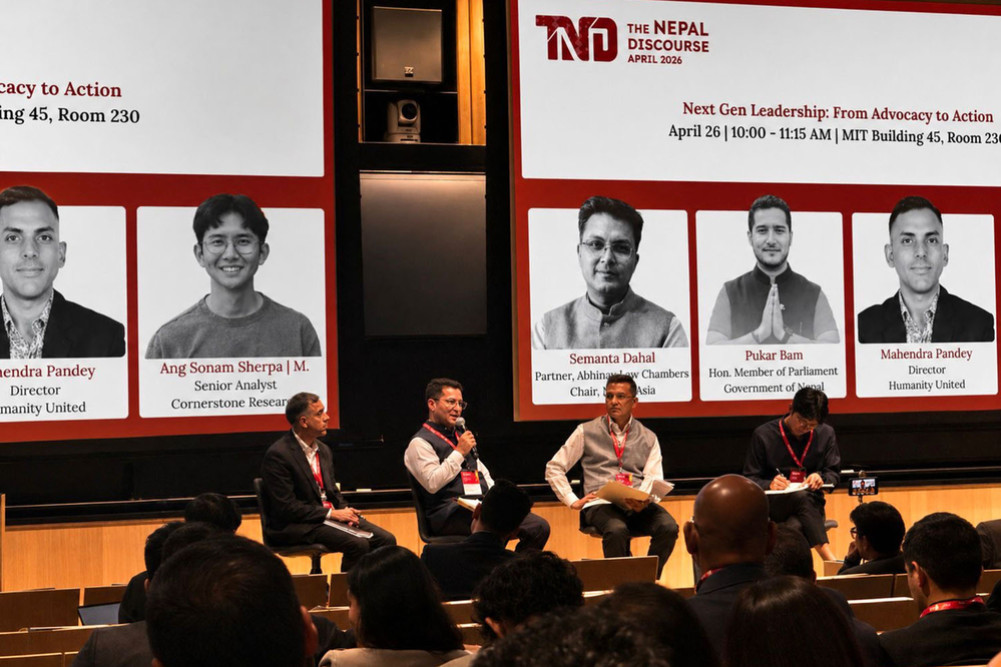
Students from Harvard University and the Massachusetts Institute of Technology (MIT) successfully concluded the first edition of “The Nepal Discourse” this weekend, bringing together one of the most ambitious global gatherings of Nepali thinkers, policymakers, entrepreneurs, academics, and diaspora stakeholders.

The two-day conference, held at Harvard University and MIT, featured more than 50 speakers and around 400 participants. Among them were 35 representatives from Nepal. Through 16 full sessions and panel discussions, participants engaged in strategic dialogue focused on four key pillars shaping Nepal’s next decade: artificial intelligence and the future of work, next-generation leadership, strong institutions, and the future of the Nepali diaspora and global Nepali community.
Finance Minister Swarnim Wagle virtually inaugurated the conference, stating that programs like “The Nepal Discourse” play an important role in connecting global Nepali expertise with Nepal’s long-term development. The event brought together prominent figures from government, academia, business, and development sectors.
Notable participants included Fusemachines founder Samir Maskey, Ncell CEO Michael Foley, Teach for Nepal CEO Swastika Shrestha, Harvard University professor Peter Blair, World Bank Director for the Maldives, Nepal and Sri Lanka David Sillsen, AAPI New Jersey Commissioner Bishnu Maya Pariyar, Member of Parliament Pukar Bam, Siddhartha Bank Chairman Rahul Agrawal, and Kimbu Tech CEO Karvika Thapa, among others.
Highlighting the significance of the program, Dr. Arun Joshi said, “Together with emerging young leaders, we aim to build a credible platform that can utilize the intellectual and economic strength of the diaspora for Nepal’s development.” He added that unlike traditional conferences, the discussions focused on how Nepal can gain a competitive advantage in an AI-driven world, strengthen institutional credibility, develop next-generation leadership, and strategically utilize diaspora networks.
The event was organized in collaboration with Leadership Academy Nepal and the Kantipur Media Group, which played an important role in shaping the conference framework and stakeholder engagement.
According to the organizers, the discussions held over the weekend will contribute to developing a long-term roadmap titled “Strategic Foresight 2035,” aimed at translating the ideas generated at the conference into actionable plans. The first edition of “The Nepal Discourse,” envisioned as a recurring platform, concluded with a shared commitment to building a stronger, more globally competitive Nepal by bridging ideas, institutions, and generations.