By Hom Lamsal,

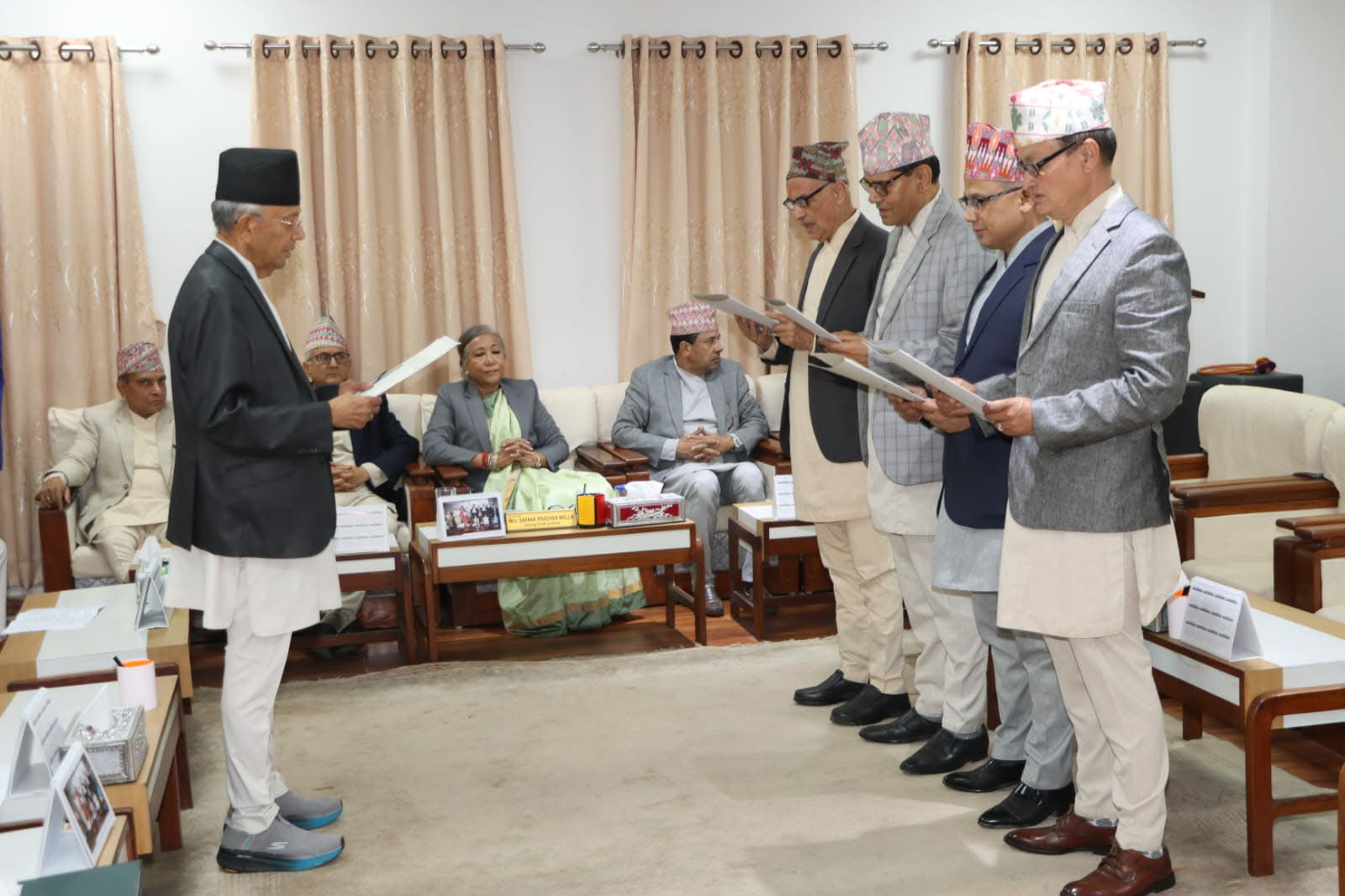
The Asset Investigation Commission formed by the new government has begun its work after establishing an office at Keshar Mahal in Kathmandu. The Cabinet meeting held on Baisakh 2 (mid-April) had formed a five-member Asset Investigation Commission under the chairmanship of former Supreme Court Justice Rajendra Kumar Bhandari. Chair Bhandari stated that the office has already been set up at Keshar Mahal and work has commenced. According to him, staff recruitment is ongoing, and with some personnel already in place, the work has started in a preliminary manner.
The commission has stated that, this time, it will also bring under investigation cases where individuals holding public office in Nepal have transferred or concealed assets abroad. It is preparing to take action if it is proven that those in public positions have illegally transferred wealth overseas through relatives. There have been widespread discussions that many high-ranking officials and political leaders have funneled money to countries such as the United States and Australia through their children or relatives. The government of Nepal reportedly has information that such funds have been used by their family members to quickly establish businesses or investments abroad, and the commission is working to bring such cases under legal scrutiny.
A member of the commission said that asset declarations will be collected, complaints received, and, if necessary under the law, statements may also be taken from public officials and their family members. Legal preparations are underway to investigate such assets regardless of whether they are located within the country or abroad, and to trace their sources. He added that over the past three decades, many political leaders and senior officials are believed to have accumulated wealth illegally and transferred it abroad, and preparations are being made to bring such cases within the legal framework.
The commission’s office has been established in the old Ministry of Education building at Keshar Mahal. Former Deputy Inspector General of Police Ganesh KC, a member of the commission, has been appointed as its spokesperson. Along with KC, the commission includes former Chief Judge of the Appellate Court Purushottam Parajuli, former High Court Judge Chandiraj Dhakal, and Chartered Accountant Prakash Lamsal as members.
The Bhandari-led commission has been mandated to operate under the Investigation Commission Act, 1969 (2026 B.S.). The commission has been given a one-year term. It has the authority to collect asset details of current, retired, and former public officials, as well as their family members, and to conduct detailed investigations. According to a commission member, statements may be taken as needed after collecting asset declarations. The commission is also preparing to collect complaints through written, verbal, electronic, and social media channels. The government has decided to deploy 32 staff members to the commission for now.
Following the formation of the Asset Investigation Commission to probe the wealth of public officials and influential individuals, former bureaucrats and politicians who have held positions of authority have reportedly become anxious. According to government sources, the commission’s objectives include identifying illegally acquired assets, examining discrepancies between income sources and assets, and investigating possible cases of corruption and abuse of power. The commission also has the authority to examine bank accounts, land and property, investments, and other assets, and to recommend freezing or confiscation of suspicious assets if necessary.
Such commissions are typically formed on a temporary basis after serious allegations of corruption emerge or during periods of political transition. In line with this practice, the current government led by Balen Shah has formed this investigation commission under special circumstances. The government is preparing to soon make public the commission’s terms of reference, structure, and working procedures. It is expected that the formation of the Asset Investigation Commission will enhance transparency in the assets of public officials and strengthen good governance.