Under the directive of the Trump administration, the U.S. Department of Justice issued an order giving high priority to citizenship revocation, claiming it is a means to control crime.
Legally, revoking U.S. citizenship is only possible for those who were naturalized—that is, individuals who obtained U.S. citizenship after immigrating from another country. U.S.-born citizens cannot have their citizenship revoked under any law.

As part of its strict immigration stance, the Trump administration ordered the Justice Department to issue a directive instructing federal prosecutors across the country to prioritize and aggressively pursue denaturalization cases. This initiative was stated to be part of the Trump administration’s broader crime-control campaign.
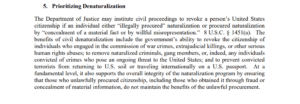
In a memorandum issued on June 11 by Assistant Attorney General Brett Shumate, it was stated that priority should be given to cases involving individuals who pose potential threats to national security—especially those connected to terrorism, espionage, or the illegal export of sensitive materials, technologies, or information—and that such individuals could have their citizenship revoked.
Shumate wrote:
“The benefits of denaturalization include the government’s ability to revoke the citizenship of individuals who have committed war crimes, extrajudicial killings, or other serious human rights violations; naturalized criminals, gang members, or anyone who poses a long-term threat to the United States. Denaturalization also prevents convicted terrorists from reentering U.S. soil or using a U.S. passport for international travel.”
Shumate’s directive, issued on June 11, further states:
“If an individual is found to have obtained citizenship illegally or by deliberately concealing important facts or providing false information, the Department of Justice may initiate civil proceedings to revoke that person’s citizenship.”
According to the letter issued by the Department of Justice:
If a person is found to have obtained U.S. citizenship illegally or by hiding critical information or knowingly providing false details, the Department of Justice may file a civil lawsuit to revoke their citizenship.
The main grounds for denaturalization include:
-
Citizenship can be revoked for those involved in war crimes, extrajudicial killings, or other serious human rights violations;
-
It allows the removal of convicted criminals, gang members, or other dangerous individuals who pose a long-term threat to the U.S.;
-
Convicted terrorists can be prevented from returning to U.S. soil or traveling internationally using a U.S. passport.
At its core, the process is intended to uphold the integrity and credibility of the U.S. citizenship program, especially by targeting individuals who obtained citizenship through fraud, deceit, or concealment of material facts.
By giving priority to denaturalization, the government aims to protect and respect lawfully acquired citizenship through a fair and legal process.
The Civil Division of the Justice Department will pursue denaturalization in all cases that are supported by evidence and legal grounds.
What is Denaturalization?
Individuals born in other countries who later acquire U.S. citizenship are known as naturalized citizens. The process of stripping them of their citizenship is called denaturalization.
This process was widely used during the McCarthy era of the 1940s and early 1950s and has continued in various forms since then. Today, approximately 25 million foreign-born individuals are naturalized U.S. citizens.
Denaturalization is mostly targeted at immigrants involved in serious crimes. For example, people who were members of the Nazi or Communist parties but falsely claimed not to be during their citizenship applications have been denaturalized and deported.
Although it was not previously a major priority, the U.S. Department of Justice has recently released a memorandum to aggressively enforce it.
Now, priority investigations and denaturalization actions are being carried out against:
-
Those with criminal backgrounds;
-
Individuals who hid or falsified information during their naturalization process;
-
Former Nazis or Communists who lied during their applications.
To make the process easier, denaturalization is now treated as a civil case, not a criminal one. This means defendants are not guaranteed legal counsel, and the burden of proof is lighter for prosecutors.
The scope has now expanded even further:
Individuals involved in Medicaid fraud, financial fraud, Medicare fraud, or those who obtained government benefits through false claims may also be subject to denaturalization.
Family members of such individuals may also be affected by these actions.