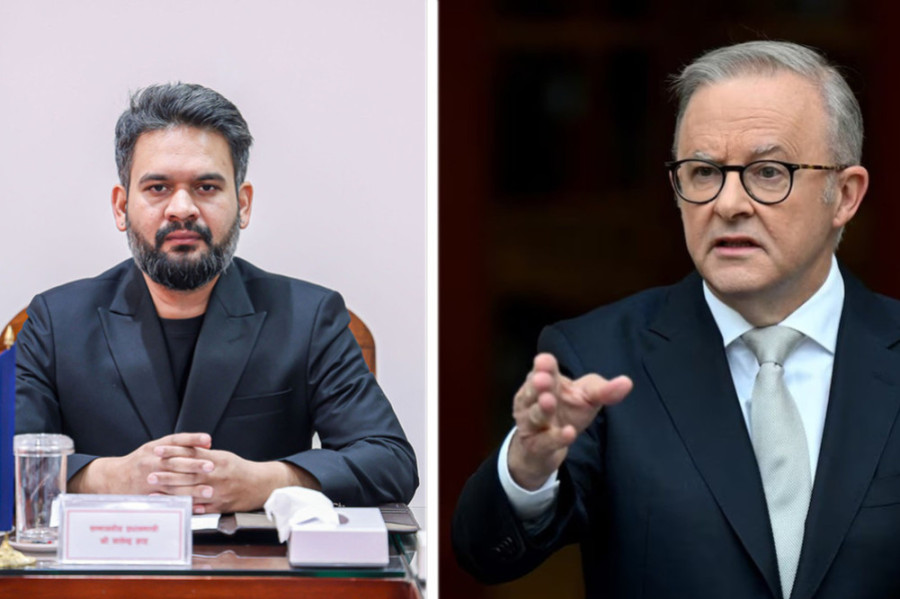
From a political perspective, the year 2082 (BS) was highly turbulent. However, toward the end of the year, a clear direction with a new mandate emerged for peace, stability, and prosperity in the country. Around the middle of the year, the rebellious “Gen Z” movement played an interventionist role in redirecting politics onto a new path.

On the strength of the Gen Z movement, the then government was ousted and the House of Representatives dissolved. A civilian government led by former Chief Justice Sushila Karki conducted parliamentary elections on Falgun 21, after which the country formed a new government.
In the election, previously ruling and traditional political parties were defeated, while the Rastriya Swatantra Party secured nearly a two-thirds majority mandate.
The parties that had led Nepal’s democratic movement have, by the end of 2082, become politically diminished. Within the Nepali Congress, leadership changed under Gagan Kumar Thapa through a special general convention, while the faction led by Sher Bahadur Deuba remains dissatisfied. The dispute over party legitimacy is still under judicial consideration.
The Communist Party of Nepal (UML) completed both its second statute convention and 11th national convention this year. KP Sharma Oli was re-elected as party leader, though the issue of generational transition remains under criticism. After electoral defeat, debates over a special convention and leadership transition have intensified within the party.
The Nepal Communist Party (NCP), which contested the election by uniting over two dozen leftist groups, also failed to achieve expected results. The party led by Pushpa Kamal Dahal “Prachanda,” rooted in the former Maoist movement, is now preparing for a special convention, while key leaders like Janardan Sharma and Sudan Kirati have left the party raising questions over policy and leadership.
Thus, 2082 is seen as a year in which old parties were criticized and a new political force emerged as the largest party. Breaking the trend of no single party achieving a majority under the existing electoral system, the Rastriya Swatantra Party won 182 seats alone, ending the narrative that coalition governments are necessary. This is the first time since the promulgation of the Constitution of Nepal (2015) that a single party has secured a clear majority.
As pledged before the election, the party appointed senior leader Balen Shah as Prime Minister. The dissolution of parliament, elections, and formation of a new government became key political events of the year. On Chaitra 13, under Article 76(1) of the Constitution, Shah was appointed Prime Minister as leader of the majority party.
The current government led by Shah is relatively inclusive, youth-representative, and small in size. From the beginning, it has implemented a 100-point governance reform agenda based on its election commitments.
Since assuming office, Prime Minister Shah has shown clear signs of avoiding past weaknesses. Instead of meeting diplomats individually, he held collective meetings to communicate the government’s priorities, indicating a focus on systemic reforms in state mechanisms.
These positive efforts are expected to serve as inspiration for improved politics in the coming year. Gaurishankar Lal Das, a centenarian and former member of the National Human Rights Commission, described 2082 as a political “tsunami” and noted that the government must act according to public sentiment. He said the current government’s initial steps are very positive.
The newly elected House of Representatives has also chosen its leadership. Dol Prasad Aryal was elected Speaker and Ruby Kumari Thakur as Deputy Speaker, and parliamentary activities have begun to gain momentum. President Ram Chandra Paudel addressed the joint session of both houses of the Federal Parliament following the elections.
During the Gen Z uprising on Bhadra 23 and 24, 76 people lost their lives. Forty-five were declared “Gen Z good governance martyrs,” and compensation was provided by the state. Key government structures including Singha Durbar, the Federal Parliament building, the Supreme Court, and Shital Niwas were damaged by fire. The total loss is estimated at around NPR 76 billion.
Another major issue this year was the Federal Civil Service Bill, where political lobbying and negligence during discussions on the “cooling period” provision were widely criticized.
The issue of irregularities in visit visas also became a major parliamentary topic, with the then opposition Rastriya Swatantra Party obstructing proceedings and demanding the resignation of Home Minister Ramesh Lekhak.
Based on recommendations of a high-level commission investigating the Gen Z movement, former Prime Minister KP Sharma Oli and former Home Minister Ramesh Lekhak were detained for investigation, drawing national and international attention. They have since been released on bail.
In the first week of Jestha, the “Sagarmatha Dialogue” was successfully held in Kathmandu, bringing global attention to climate change issues from the Himalayas to the seas.
Key events of 2082:
- Deaths of prominent leaders including Tirtharam Dangol and Pradeep Nepal
- Agreement with protesting teachers and employees
- Appointment of Dr. Bishwo Paudel as Governor of Nepal Rastra Bank
- Record Everest ascent by Kami Rita Sherpa (31st time)
- National budget announcement (NPR 1.964 trillion)
- Start of electricity export to Bangladesh
- Discovery of natural gas in Dailekh
- Flood disaster in Rasuwa
- Rescue of Nepali women from Iranian prisons
- Gen Z protests leading to deaths, resignation of Home Minister, and PM Oli’s resignation
- Appointment of Sushila Karki as Prime Minister and dissolution of parliament
- Formation of investigation commissions and political agreements
- Party conventions and leadership changes
- Parliamentary elections held peacefully on Falgun 21
- Appointment of Balen Shah as Prime Minister and formation of a 15-member cabinet
Overall, 2082 stands out as a year of dramatic political transformation, marked by upheaval, reform efforts, and the rise of new political leadership in Nepal.