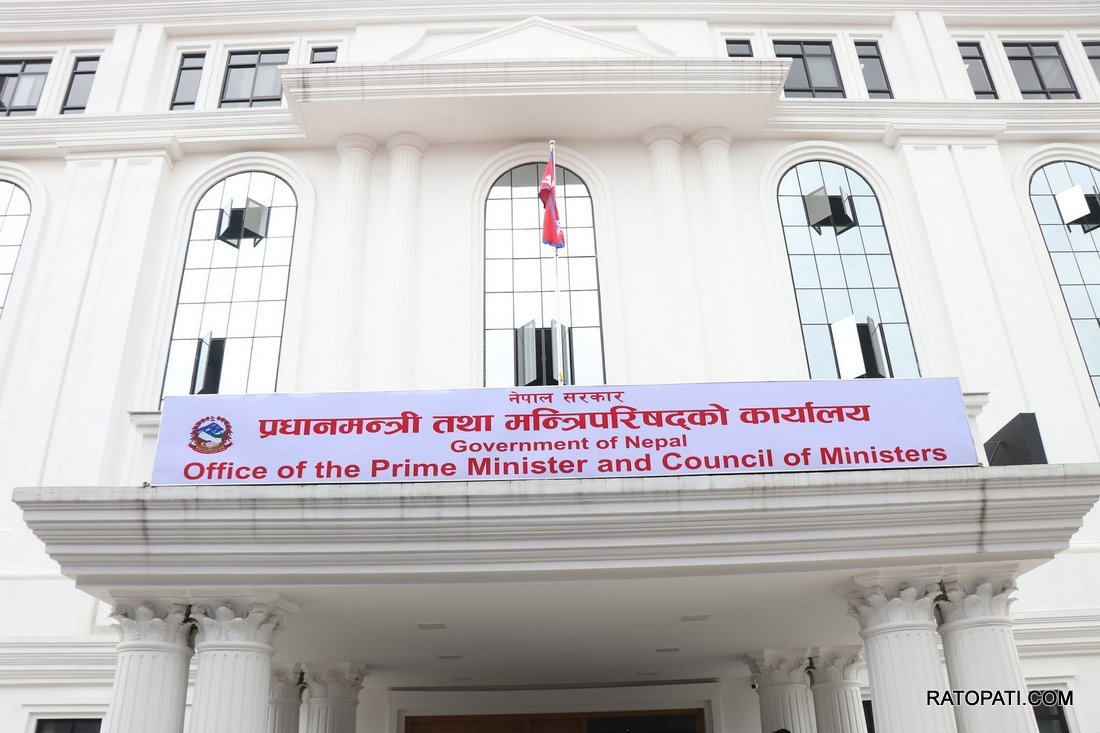
Chief Secretary Suman Raj Aryal, who had been serving as one of Prime Minister Balendra Shah’s key administrative aides, was bid farewell on June 25 by Prime Minister’s Adviser Asim Shah. Traditionally, the prime minister himself bids farewell to a chief secretary. The unusual decision to send an adviser instead, after Aryal had served alongside Prime Minister Shah for more than three months, has generated discussion and suspicion within the civil service.

Government employees did not view the incident in isolation. Earlier, then-Secretary Krishna Hari Pushkar had been arrested reportedly on the basis of a mobile phone message, adding to a growing sense of uncertainty among senior bureaucrats.
The civil service was already unsettled by the instructions Prime Minister Shah gave secretaries on his first day in office. Immediately after taking the oath on March 27, he reportedly told senior officials that they had previously worked in the interests of elected representatives rather than the public and warned them not to repeat that practice.
“You entered the civil service after passing the Public Service Commission examination. The ministers serving today are more educated than you are, so do not try to teach us,” one secretary quoted the prime minister as saying.
According to the secretary, Shah also instructed officials not to use laws and regulations as an excuse to avoid work or lecture ministers about legal provisions.
“Match your speed with ours. Otherwise, clear the way by resigning,” the prime minister reportedly told the officials.
The passport case further intensified anxiety among civil servants. On June 15, on the direction of the Prime Minister’s Office, the Commission for Investigation of Abuse of Authority (CIAA) arrested Tirtha Raj Aryal, then Director General of the Department of Passports, and decided to prosecute him. He was arrested from the Prime Minister’s Office itself. The incident reportedly deepened the sense of fear among government employees.
Following the publication of a photograph showing the farewell of the chief secretary, dissatisfaction began emerging within the civil service. Former spokesperson of the Rastriya Swatantra Party and lawmaker Manish Jha said in an interview that the incident should not have happened in that manner from the Prime Minister’s Office.
“It is too early to say that everything happening now is driven by bad intentions, but the way things have been handled is certainly not appropriate,” Jha said.
The chief secretary is the highest-ranking official in the civil administration. Sending an adviser instead of the prime minister to bid farewell to the chief secretary was perceived by many civil servants as disrespectful.
Since then, reports have emerged of senior officials facing increasing pressure, restrictions on their ability to work, preferential treatment toward those close to the political leadership, and demands to undertake actions beyond the established legal framework. As a result, many senior officials are reportedly becoming increasingly apprehensive about continuing in government service.
Some secretaries have already resigned, while several others are reportedly considering leaving their positions. If the trend continues, officials warn that the government could face a significant administrative vacuum.
Proposed Civil Service Reforms Behind the Resignations
The resignation trend among senior civil servants—particularly secretaries and joint secretaries—does not appear to be driven solely by personal reasons. It is increasingly being linked to the government’s proposed restructuring of the civil service, uncertainty over careers and benefits, and the relationship between political leadership and the bureaucracy.
One of the biggest issues is the proposed Federal Civil Service Bill. The government has proposed that civil servants reaching the age of 55 or completing 30 years of service could be compulsorily retired under a transitional arrangement.
The existing legal retirement age is 58. The proposed bill, however, has not yet been formally registered in Parliament.
If the proposed retirement provision becomes law in its current form, around 10,000 civil servants could leave government service earlier than expected. The group could include more than 50 secretaries, around 260 joint secretaries and more than 700 under-secretaries.
If implemented, the provision would result in the simultaneous departure of a large number of experienced officials. Preliminary estimates suggest that up to 52 secretaries could be affected at once.
This is believed to be one reason why some long-serving officials may be choosing to resign before the proposed new system takes effect, in an attempt to secure the benefits available under the existing system.
The resignations of Secretary of the Ministry of Communications Dr. Kamal Prasad Pokharel and Secretary at the Office of the Prime Minister and Council of Ministers Baburam Adhikari have also been viewed in this context.
Adhikari was only days away from retirement, while Pokharel still had approximately one year remaining in his term. Officials who have completed more than 30 years of service may be seeking to protect their existing retirement and other benefits by resigning before the proposed changes come into effect.
Concern Over Loss of Experienced Officials
The prospect of a large number of experienced civil servants leaving at the same time has raised concerns within Nepal’s administrative sector.
Officials have acknowledged that discussions are underway regarding how the proposed retirement provisions should be implemented. Administrative experts have particularly warned that the sudden departure of experienced personnel from sectors such as justice, health and highly specialized technical services could affect service delivery and institutional continuity.
The proposed legislation also reportedly seeks to reduce the maximum tenure of a secretary from five years to three years. This has created additional uncertainty among serving secretaries as well as joint secretaries waiting for promotion.
The government led by Prime Minister Balendra Shah has been preparing to make the federal administration smaller, less expensive and more officer-oriented. It is reportedly preparing to eliminate around 1,800 civil-service positions, including approximately 10 secretary-level posts.
The government has also proposed gradually eliminating positions at the non-gazetted first- and second-class levels—such as Kharidar and Nayab Subba—from federal ministries over the next three years.
These measures indicate that Nepal’s existing administrative structure could undergo substantial change.
Promotion Freeze Adds to Uncertainty
The promotion process for secretaries has also been delayed for an extended period. By mid-August, 10 of the approximately 70 secretary-level positions had reportedly become vacant, with more expected to become vacant.
The situation has created additional uncertainty among joint secretaries regarding their career prospects.
At the same time, the government has decided not to recruit new permanent civil servants during the current fiscal year. Government offices are reportedly required to obtain approval from the Prime Minister’s Office before even sending requests to the Public Service Commission to fill vacant positions.
This has created an unusual situation: experienced employees are retiring or resigning, while the entry of new employees is simultaneously being restricted.
Fear, Political Pressure and Administrative Uncertainty
Reports of growing dissatisfaction within the civil service have cited several factors, including career uncertainty, political interference, uncertainty over transfers and promotions, decisions concerning trade unions and reductions in government positions.
Therefore, it would be incomplete to describe the recent resignations simply as “personal decisions.”
The proposed 55-year-age/30-year-service retirement provision, uncertainty over career progression and benefits, ambiguity surrounding promotion and tenure for secretaries and joint secretaries, reductions in civil-service positions, restrictions on new recruitment and growing insecurity among government employees have all become significant issues.
Of course, individual, health, family, overseas employment and other administrative reasons may also explain some resignations. But recent developments suggest that the proposed Civil Service Bill is an important part of the broader background.
More importantly, senior officials have increasingly expressed dissatisfaction over what they describe as extensive interference, pressure and intimidation from the prime minister, ministers and their advisers since the formation of the new government.
This has left some officials facing a difficult choice: continue working under increasing pressure or resign before they become personally responsible for decisions they believe may later expose them to legal consequences.
There is also a long-standing concern within Nepal’s bureaucracy that officials may be instructed to disregard established procedures and later be held responsible because they signed the documents.
That perception appears to be contributing to a new mindset among some senior officials: rather than remain in office, implement decisions under political pressure and potentially face investigation later, it may be safer to leave the government service altogether.
Only a few resignations have become public so far. But senior officials warn that the situation could develop into a much broader wave of resignations.
If that happens, Nepal could face a serious administrative crisis—not simply because officials are leaving their jobs, but because the state could simultaneously lose experienced institutional knowledge, restrict new recruitment and weaken the continuity of decision-making at the highest levels of government.