The revelation that hundreds of Rohingya are living in the Kathmandu Valley has once again raised questions about how they entered Nepal, who facilitated their entry and what their legal status is.

Following the long-standing presence of Tibetan refugees in Kathmandu, Rohingya, Afghan and Pakistani refugees are also increasingly being identified in the capital. Security agencies are reportedly concerned that the growing presence of undocumented foreign nationals could pose additional security challenges in Kathmandu and have informed the government accordingly.
On Friday, Nepal Police initially said that the number of Rohingya in the Kathmandu Valley had reached 568. However, a subsequent revised figure put the number at 526. According to police, there are 162 men, 148 women and 216 children among them. They have been found living in Kapan, Lasuntar, Ram Mandir, Lubhu and Sunakothi in Lalitpur.
But even after the figure was revised, the central questions remain: How did people displaced from Myanmar’s Rakhine State reach Nepal? Are they refugees seeking international protection, or are they undocumented migrants who entered Nepal illegally?
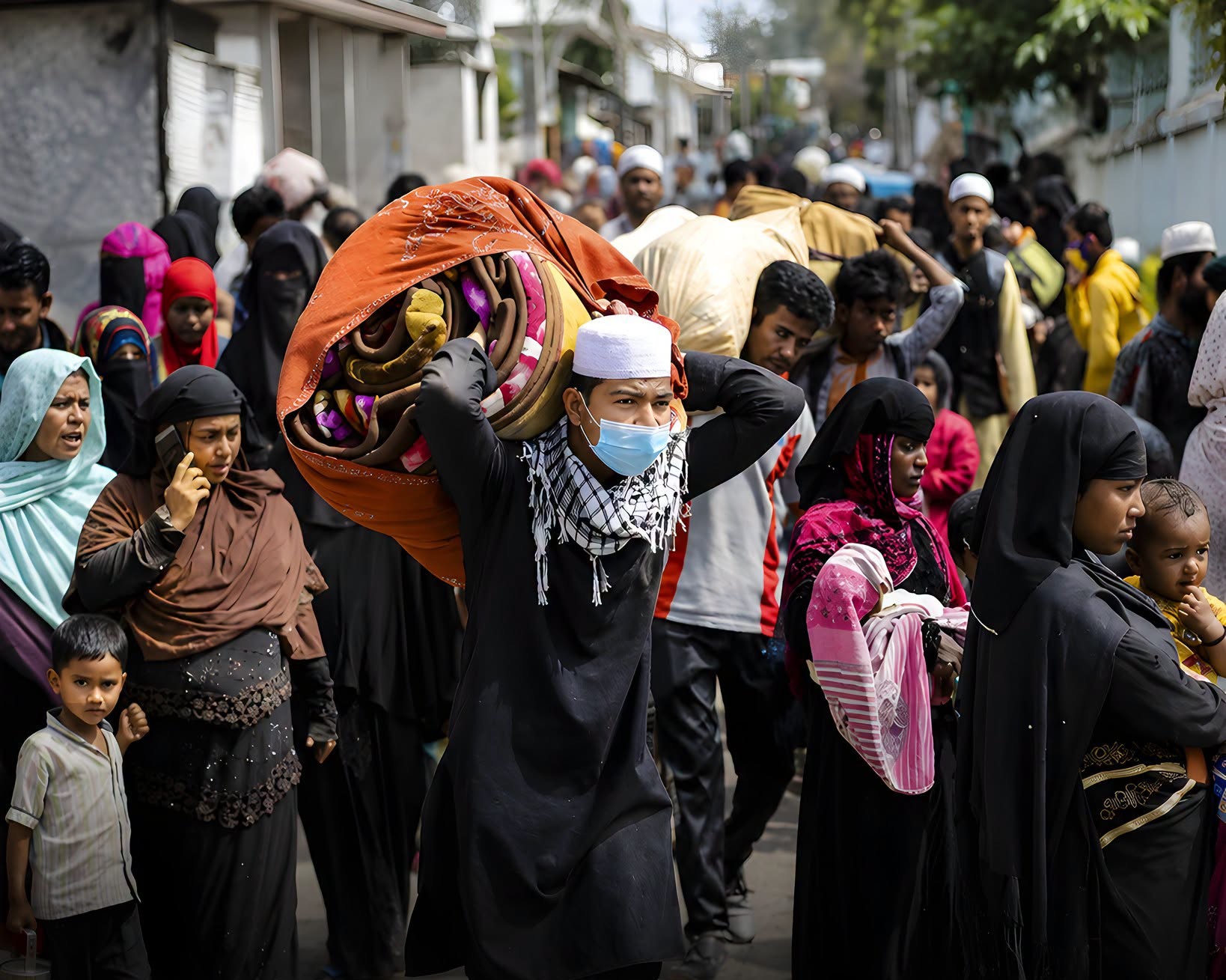
The Rohingya are a Muslim minority community that has lived in Myanmar for generations. Discrimination over citizenship, violence and military operations have forced large numbers of Rohingya to flee the country. Following the Myanmar military’s 2017 crackdown, more than 700,000 Rohingya fled to Bangladesh. More than one million Rohingya refugees are still believed to be living in Bangladesh.
Some Rohingya have also been living in India. With the change of government in the Indian state of West Bengal, some are reportedly concerned about their security in India and have subsequently moved toward Nepal.
Nepal and Myanmar do not share a border. Therefore, Rohingya reaching Nepal must travel through at least two other countries.
According to people familiar with the movement of the Rohingya community, many of those now in Nepal are believed to have travelled from Myanmar to Bangladesh, then through India and into Nepal.
Some reports have indicated that Rohingya entered Nepal from Bangladesh through India using the open India–Nepal border. A recent Nepal Police report also stated that the 526 Rohingya entered Nepal through different border points after travelling through India.
This raises a serious security question: Where and why did immigration checks fail when these people entered Nepal? Or, if checks were conducted, were some individuals allowed through because of collusion? a security source told Khabarmala.
Previous incidents suggest that the Kakarbhitta border point in eastern Nepal could be one of the routes used by Rohingya entering Nepal.
In 2021, Nepal Police arrested 14 Rohingya after they reached Kathmandu. According to the police investigation at the time, they had travelled from Rohingya refugee camps in Bangladesh through India and entered Nepal via the Kakarbhitta border.
This does not mean that all of the Rohingya currently identified in Kathmandu entered through Kakarbhitta. Police have said that they used different border points.
Therefore, authorities need to establish individual travel records showing which border point each person used, when they entered Nepal and how they eventually reached Kathmandu.
Another unanswered question is whether intermediaries charged money to facilitate their journey across the border or whether the Rohingya travelled independently.
Who brought them to Kathmandu? Who arranged accommodation for them? Who helped them establish themselves in the capital?
The answers to these questions have yet to emerge from the police investigation.
Nepal is not a party to the 1951 Refugee Convention or the 1967 Protocol. The country also does not have a comprehensive standalone national refugee law.
However, this does not automatically mean that every person seeking asylum in Nepal is an “illegal migrant.”
The absence of a comprehensive national refugee framework creates a complicated policy situation. Nepal does not have a clear national legal system governing refugees, yet the number of foreign nationals seeking protection in the country has continued to grow.
Available reports indicate that Rohingya began arriving in Nepal as early as 2012. Some families reportedly travelled through India and eventually settled in Kathmandu’s Kapan area.
Following the large-scale arrival of Rohingya in Bangladesh after 2017, their movement across South Asia entered a new phase. For Nepal, the issue has both security and humanitarian dimensions.
The actual number of Rohingya living in Nepal has been difficult to establish for years. An analysis published in 2026 estimated that the number could range from 600 to 3,000, while acknowledging the difficulty of establishing an accurate figure.
Against this background, the police announcement that 526 Rohingya have been identified in the Kathmandu Valley alone is more significant than a routine administrative statistic.
The situation is particularly complicated because many Rohingya may not possess Myanmar passports or citizenship documents.
Some may already have lived as refugees in another country before travelling through India into Nepal.
Therefore, the question is not simply “How did they enter Nepal?”
The more important questions are: What is their legal basis for staying in Nepal? What documents do they possess? Are they registered with UNHCR? And what are the security and legal implications of their continued stay?
These questions require individual verification rather than assumptions based solely on ethnicity or nationality.
The Ministry of Home Affairs has refugee affairs, border security and immigration-related matters within its area of responsibility.
The ministry’s Border and Immigration Administration Division is responsible for issues including international border security, collection of information relating to border crimes and measures to control cross-border criminal activities.
However, the ministry has not, so far, publicly issued a separate formal statement specifically addressing the 526 Rohingya identified in the Kathmandu Valley.
The Department of Immigration is the principal government agency responsible for the entry and stay of foreign nationals in Nepal.
However, the department has also not issued a separate public response regarding the latest police figure on the Rohingya population.
In a separate recent incident, an undocumented Rohingya man found in Saptari was reportedly not accepted by the Department of Immigration and was subsequently taken to a humanitarian shelter. The incident highlighted the policy and institutional uncertainty surrounding the management of undocumented asylum seekers in Nepal.
Nepal Police Headquarters spokesperson Abinarayan Kafle said that Rohingya had entered Nepal from the Nepal–India border at different times.
Speaking at a press conference at Police Headquarters, Kafle said identifying Rohingya had become difficult because their physical appearance is similar to that of Nepalis, the Nepal–India border is open, and technology-based security surveillance is inadequate.
He said security personnel deployed along the border had been instructed to prevent such individuals from entering Nepal.
The police statement has brought renewed attention to the effectiveness of Nepal’s open-border management and the need for technology-based identification and surveillance systems.
According to the United Nations High Commissioner for Refugees (UNHCR), Nepal is home to more than 20,000 refugees from different countries and communities.
The refugee population includes long-established Tibetan refugees, Bhutanese refugees and refugees or asylum seekers from other countries.
The presence of Rohingya in Kathmandu therefore needs to be examined separately from the broader refugee population. The legal status of each individual can vary depending on whether the person is registered with UNHCR, has refugee status, is seeking asylum or has entered the country without valid documentation.
Border security agencies have recently increased surveillance along the Nepal–India border.
At the Rani border point in Morang, identity checks for people entering Nepal have reportedly been tightened, with joint teams from Nepal Police and the Armed Police Force deployed to monitor movement.
The latest developments have therefore brought three issues into sharper focus: open-border management, refugee protection and national security.
The challenge for Nepal is not simply to determine how many Rohingya are living in Kathmandu.
Authorities must establish how each individual entered Nepal, what their legal status is, whether they are registered with UNHCR, whether intermediaries or trafficking networks were involved, and whether any national-security concerns actually exist.
At the same time, any investigation must distinguish between legitimate security concerns and the humanitarian obligations owed to people who may have fled persecution and statelessness.
The real question is therefore not merely how hundreds of Rohingya reached Kathmandu, but whether Nepal has the legal and institutional mechanisms necessary to manage refugees, asylum seekers and undocumented foreign nationals while simultaneously protecting its borders.