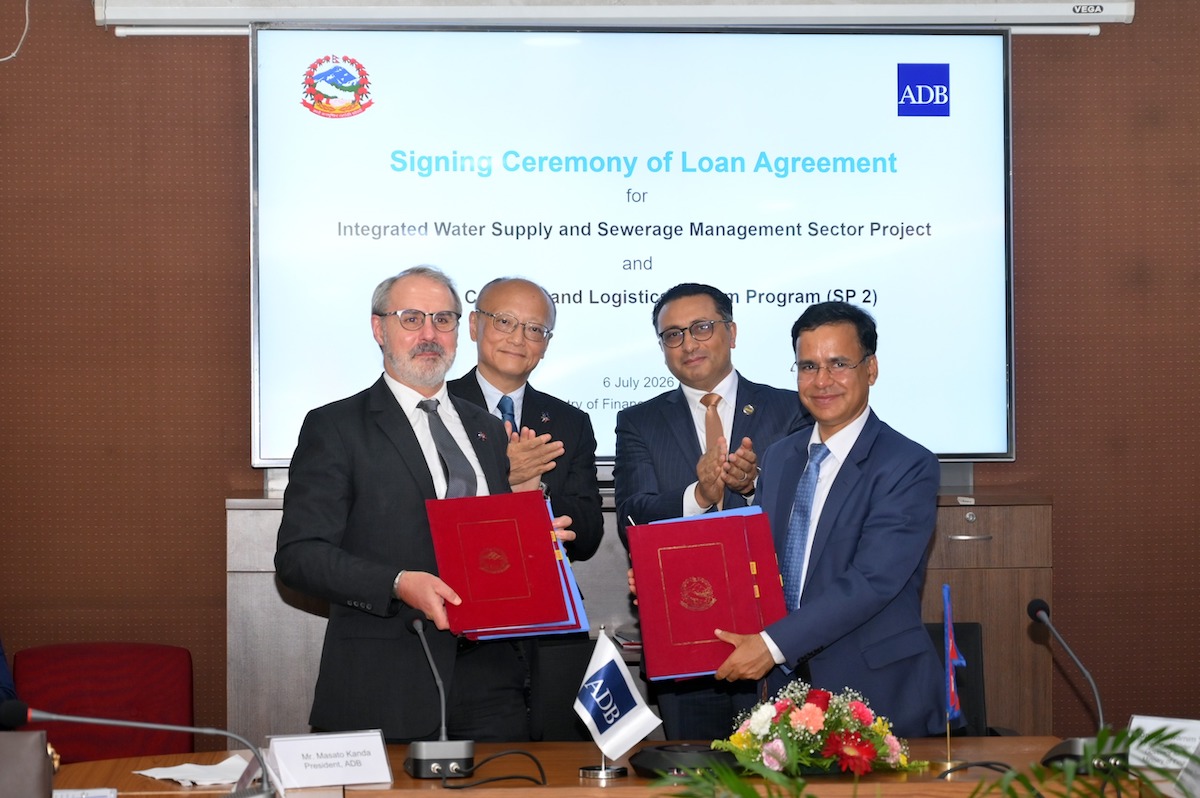
The Government of Nepal and the Asian Development Bank (ADB) have signed concessional loan agreements worth $165 million (approximately Rs. 25.17 billion) to finance two major development projects.

The agreements were signed on Monday during ADB President Masato Kanda’s official visit to Nepal in the presence of Finance Minister Swarnim Wagle. Nepal’s Finance Secretary Ghanshyam Upadhyaya and ADB Nepal Resident Director Arnaud Cauchois signed the agreements on behalf of their respective sides.
According to Nepal’s Ministry of Finance, $115 million will be used to implement the Integrated Water Supply and Sewerage Management Project, while $50 million will be provided as budget support for the South Asia Subregional Economic Cooperation (SASEC) Trade Facilitation Program, aimed at modernizing customs procedures and logistics services.
Speaking at the signing ceremony, Finance Minister Wagle praised ADB’s long-standing support for Nepal’s development and expressed confidence that the partnership would continue to grow stronger. ADB President Kanda reaffirmed the bank’s commitment to deepening its six-decade partnership with Nepal and expanding development cooperation.
The Asian Development Bank remains one of Nepal’s largest multilateral development partners. According to ADB, by the end of 2024 it had committed more than $9.3 billion through 519 loans, grants, and technical assistance projects supporting Nepal’s development.
With the signing of the new $165 million financing package, ADB’s total development commitment to Nepal has increased further. The bank is currently financing multi-billion-dollar projects across key sectors including energy, roads, drinking water, irrigation, education, healthcare, urban infrastructure, climate resilience, and economic reforms.
ADB says it remains committed to supporting Nepal’s long-term development through investments in infrastructure, improved public service delivery, and sustainable economic growth.
Editorial Note: The original Nepali text concludes with a commentary stating that despite the Balen-led government’s initial position that Nepal should reduce dependence on foreign aid and increase domestic production, the government has continued to accept foreign assistance since its first Cabinet meeting. This statement represents an opinion or political commentary rather than a verified news fact and should be presented as analysis or editorial content rather than as part of the factual news report.