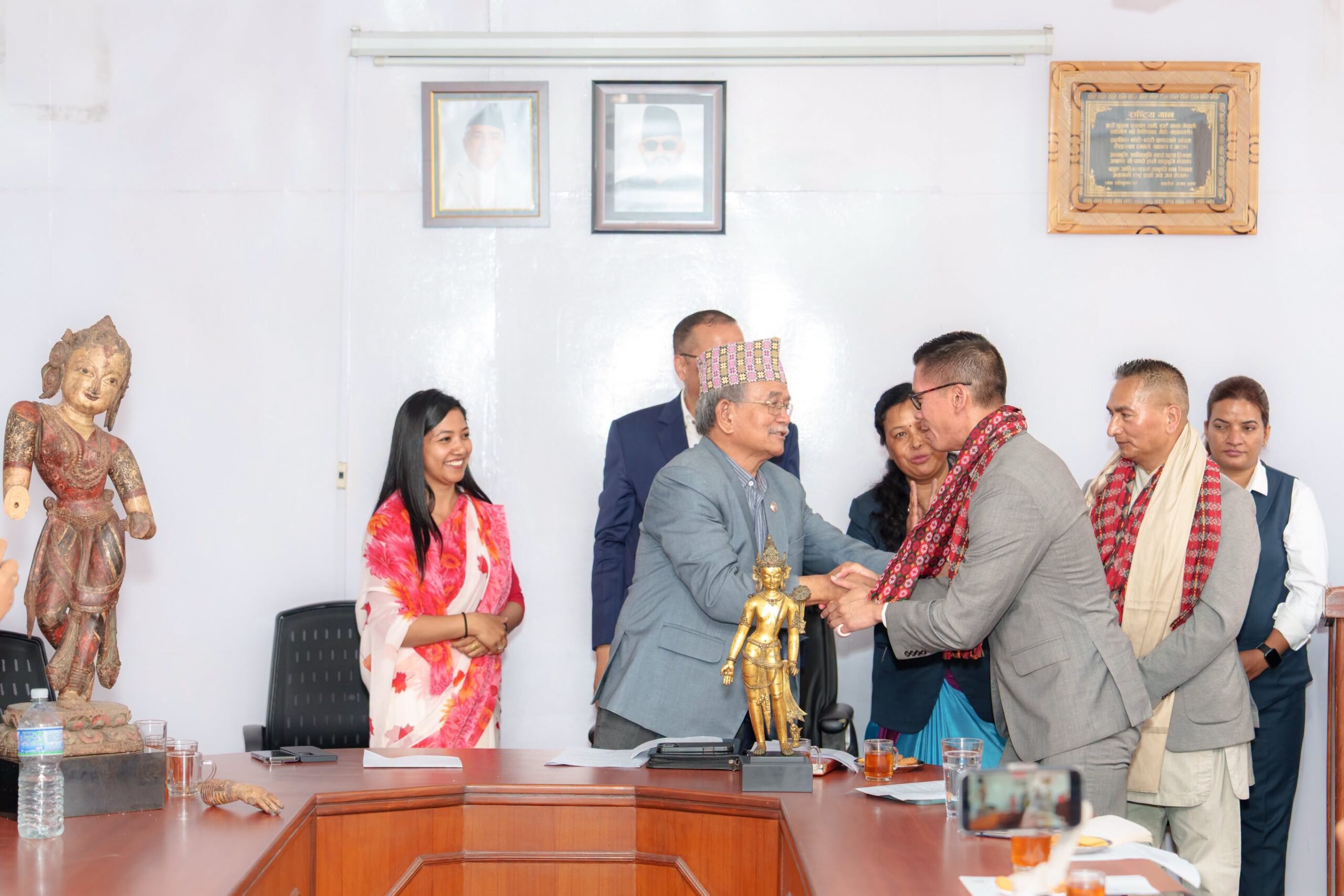
The United States has returned two more sacred cultural artifacts to Nepal, marking another milestone in the two countries’ longstanding cooperation to combat the illicit trafficking of cultural property and preserve Nepal’s rich cultural heritage.

At a repatriation ceremony held Monday at Nepal’s Department of Archaeology, U.S. officials formally handed over a 13th-century gilt bronze Padmapani and a 16th-century polychromed wooden Nrityadevi (Dancing Goddess) statue to the Government of Nepal.
The latest repatriation brings the total number of Nepali antiquities returned from the United States to 127, according to the U.S. Embassy in Kathmandu.

Speaking at the ceremony, U.S. Embassy Public Affairs Chief Mike Harker said the growing number of recovered artifacts reflects the strength of bilateral cooperation in protecting cultural heritage and dismantling international antiquities trafficking networks.
“To date, 127 Nepali antiquities have been returned from the United States to their rightful homes in Nepal,” Harker said. “The return of these two sacred statues further strengthens our partnership and demonstrates how criminal investigations, diplomatic coordination, and community advocacy can work together to disrupt illicit antiquities trafficking. The new U.S.-Nepal Cultural Property Agreement provides an even stronger foundation for future cooperation.”
The recently enacted U.S.-Nepal Cultural Property Agreement establishes a comprehensive framework for closer collaboration between the two countries in preventing the illegal trade of cultural objects. The agreement includes measures to support joint investigations, strengthen information sharing, restrict the import of illegally exported antiquities, and safeguard Nepal’s cultural heritage for future generations.

For decades, hundreds of Nepal’s religious and archaeological treasures—including stone and metal sculptures, temple carvings, inscriptions, and sacred icons—were stolen from temples, monasteries, and public heritage sites before finding their way into international museums, private collections, and the global art market. The thefts were particularly widespread between the 1960s and the 1990s, when many historic sites lacked adequate protection.
In recent years, however, collaborative efforts involving the Government of Nepal, U.S. law enforcement agencies, international investigators, museums, researchers, and cultural heritage advocates have led to the successful identification and recovery of dozens of stolen artifacts.
Experts say advances in digital archives, historical documentation, social media, and provenance research have significantly improved the ability to trace stolen objects and establish their origins. Once identified, many artifacts have been repatriated through legal proceedings, diplomatic negotiations, and voluntary cooperation from museums and private collectors.
The United States congratulated the Government and people of Nepal on the latest repatriation and reaffirmed its commitment to continuing cooperation in protecting cultural heritage, promoting the rule of law, and preserving Nepal’s remarkable history.
Archaeologists describe the returned Padmapani and Nrityadevi statues as far more than historical artworks. They are revered religious icons and enduring symbols of Nepal’s cultural identity, spiritual traditions, and living heritage. Their return not only restores valuable works of art but also represents an important step toward cultural justice and the restoration of community heritage.
Nepal has recovered dozens of stolen cultural artifacts from the United States, the United Kingdom, Australia, and several other countries in recent years, making the international repatriation of its heritage one of the country’s most notable cultural preservation achievements.