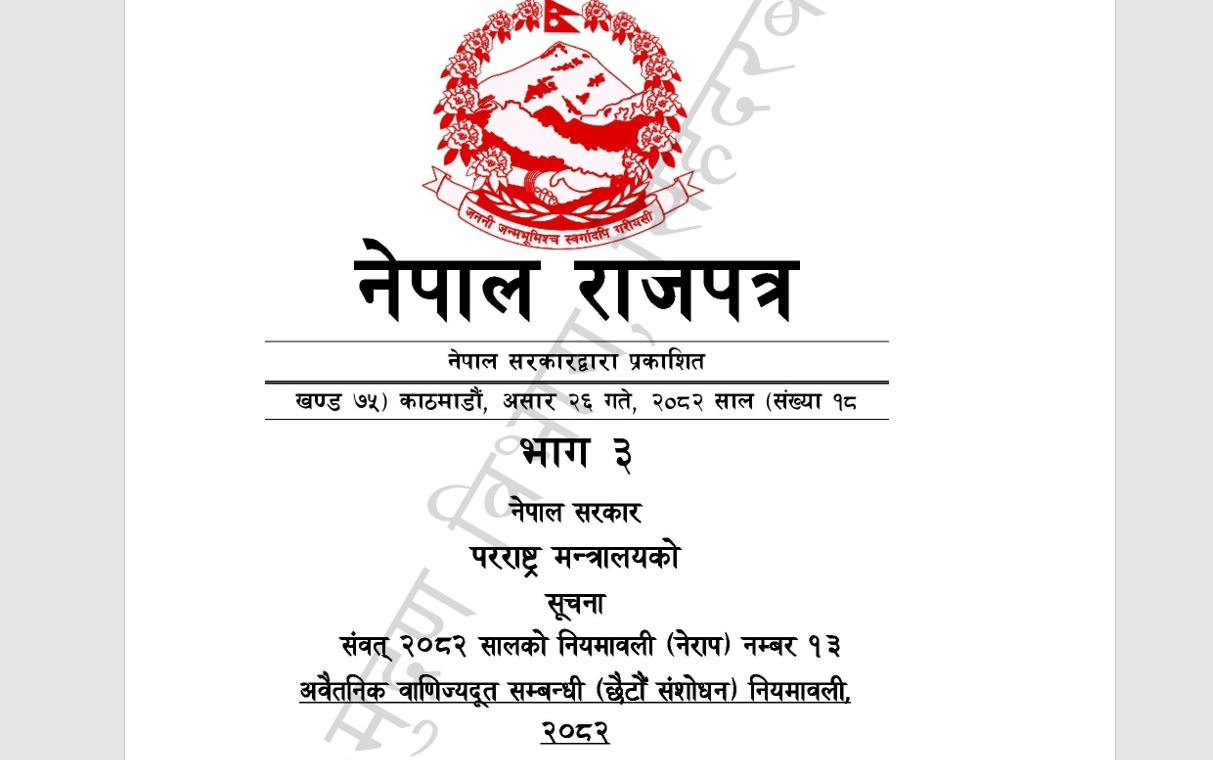
After widespread complaints regarding arbitrary appointments based on political access and excessive misuse of visit visas, the Government of Nepal has amended the regulations related to the qualifications and dismissal of unpaid honorary consuls appointed abroad. The amendment defines the necessary qualifications for appointment and strengthens provisions regarding dismissal. The sixth amendment to the Unpaid Honorary Consul Regulations has been published in the 2082 Gazette. According to the notice published in the Gazette on Asar 26, the Unpaid Honorary Consul Regulations, 2039, have been amended for the sixth time.


According to the amendment, qualifications have been specified to be appointed as an unpaid honorary consul. These include: being a foreign citizen of Nepali origin (i.e., a citizen of the country to which they are appointed), having no convictions in Nepal related to crime, fraud, or money laundering, and being ineligible if citizenship or permanent residency was obtained through asylum or refugee procedures. The individual must not be involved in any legal case against the Government of Nepal or be found guilty, and must not have any criminal charges in Nepal or the country of residence. Likewise, the individual must have resided in the concerned country for at least 10 years, be proficient in the primary language spoken there, show no signs of moral misconduct, and have the financial capacity to open and operate an office at their own expense.

A new clause added in this amendment refers to a past complaint received by the Ministry stating that three individuals—two in U.S. cities and one in an Australian city—who applied for appointments had acquired citizenship through asylum in those countries.
If a person appointed for four years needs to be removed, the provision allows for their removal upon the recommendation of the ambassador of the concerned country and a proposal submitted by the Ministry of Foreign Affairs to the Council of Ministers. Grounds for dismissal include: acting against the policies of the Government of Nepal, acting against the goodwill of the Nepali community, moral misconduct, being convicted by a court, being found guilty of money laundering, or if a salaried diplomatic mission of the Government of Nepal is established in the same city, in which case the honorary consul will automatically be dismissed.
If a previously appointed person wishes to apply for another term, they must submit an application to the concerned embassy or ministry along with a work progress report three months before the end of their term. If the government deems the performance satisfactory, they may be reappointed for another four-year term, as published in the Gazette.
Recently, complaints have been filed with the Ministry of Foreign Affairs and the Commission for the Investigation of Abuse of Authority (CIAA) regarding severe abuse of power by unpaid honorary consuls in the U.S., Australia, and some European countries, including calling individuals on visit visas and demanding large financial transactions. Although the outcome of these investigations remains uncertain, the ministry has stated that the recent amendment has improved the appointment process to some extent.