
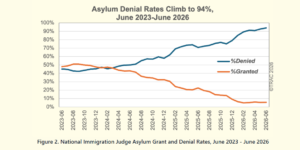
Study shows a dramatic shift in U.S. immigration courts as the Trump administration restructures the immigration judiciary . A new study has concluded that obtaining asylum in the United States is becoming increasingly difficult, with the asylum denial rate in immigration courts exceeding 94 percent.
The findings suggest that the era in which migrants could relatively easily obtain asylum in the United States is, to a significant extent, coming to an end. The data also indicate that asylum approval rates could remain substantially lower than in previous years regardless of who occupies the White House in the future.

Researchers view the trend as part of a broader global tightening of immigration policies, with countries increasingly adopting stricter approaches toward asylum and migration.
According to new data released by the nonpartisan research organization Transactional Records Access Clearinghouse (TRAC), the rate at which asylum cases are being denied by U.S. immigration judges has risen sharply as the Trump administration undertakes a major restructuring of the nation’s immigration court system.
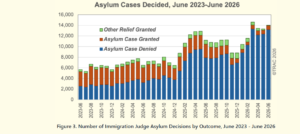
In June 2026 alone, immigration judges decided more than 14,000 asylum cases. Only 771 people were granted asylum, while 94.1 percent of cases were denied, according to the TRAC analysis.
The figures show a dramatic decline in the asylum grant rate. By June 2026, the asylum grant rate had fallen to just 5.5 percent, substantially lower than in previous years.
According to TRAC, the asylum grant rate exceeded 50 percent during the early years of President Joe Biden’s administration. By the end of Biden’s presidency, however, the rate had declined to approximately 32 percent.
The sharp change has occurred amid what TRAC has described as a “radical transformation” of the U.S. immigration court system.
279 Immigration Judges Fired or Resigned
Analyzing records from the Executive Office for Immigration Review (EOIR), TRAC reported that 279 immigration judges were either fired or resigned during fiscal years 2025 and 2026.
That figure represents approximately 38 percent of the 735 immigration judges who were serving at the end of fiscal year 2024, the final full fiscal year of the Biden administration.
At the same time, the Trump administration has brought new and temporary judges into the immigration court system.
According to the study, of the 743 judges who decided asylum cases during fiscal year 2026, only 322 had already been serving as immigration judges before President Donald Trump took office.
That means more than half of the judges deciding asylum cases during the period had entered the system after Trump assumed office.
However, the increase in asylum denials cannot be explained solely by the replacement of immigration judges. The data indicate that asylum denial rates have also increased among judges who remained on the bench.
Denial Rates Also Rose Among Judges Who Stayed
TRAC examined 130 immigration judges who remained on the bench and actively issued asylum decisions throughout fiscal years 2021 through 2026.
Approximately three-quarters of those judges had higher asylum denial rates in fiscal year 2026 than they did in fiscal year 2021.
Among those judges, the average increase in the denial rate was 33 percentage points, while the median increase was 28 percentage points.
The findings suggest that the dramatic increase in asylum denials cannot simply be attributed to the arrival of new judges. The decision-making environment and the composition of cases before the courts also appear to have changed substantially.
Why Are More Asylum Cases Being Denied?
TRAC’s analysis emphasizes that asylum denial rates are influenced by a range of factors and cannot be attributed solely to an individual judge’s philosophy.
These factors include:
- the types of cases appearing on a judge’s docket;
- whether applicants are detained;
- current immigration policies;
- access to legal representation;
- the nationality of the asylum seeker; and
- other circumstances beyond an individual judge’s control.
The availability of legal representation and the nationality of asylum seekers can have a significant impact on asylum outcomes. TRAC therefore compares each judge’s caseload with the nationwide asylum caseload based on these factors.
192 New Judges and 53 Temporary Judges
The U.S. Department of Justice has also expanded the immigration judge workforce under the Trump administration.
According to the study, 192 new immigration judges have been appointed, while another 53 temporary judges have joined the immigration court system.
The changes have significantly altered the composition of the immigration judiciary within a relatively short period.
Of the 743 judges who decided asylum cases in fiscal year 2026, only 322 were already serving before Trump took office. More than half had therefore entered the system after the beginning of the Trump administration.
But the data show that new judges alone do not explain the rise in asylum denials.
Immigration Courts Are Processing Cases at a Record Pace
The study also points to a dramatic increase in the speed at which immigration courts are resolving cases.
In June 2026, immigration courts completed 100,773 cases, the highest monthly total recorded to date, according to the study.
Immigration judges also issued a significantly higher number of removal-related orders during the same period.
The development suggests that U.S. immigration courts are increasingly becoming not only a venue for deciding asylum claims but also a major legal mechanism through which the Trump administration’s accelerated deportation campaign is being carried out.
A 94 Percent Denial Rate Does Not Mean Every Applicant Has a 94 Percent Chance of Losing
The national asylum denial rate should not be interpreted as meaning that every asylum seeker has a 94 percent probability of losing his or her case.
The outcome of an asylum case can vary considerably depending on the judge, court location and individual circumstances of the applicant.
Whether an applicant is detained, has legal representation, and can present specific evidence supporting the asylum claim can also significantly affect the outcome.
Therefore, the 94 percent national denial figure represents a broader trend in the immigration court system rather than an automatic prediction of the outcome of any individual case.
The Immigration Court System Is Changing
TRAC’s latest judge-by-judge report provides a detailed comparison of asylum denial rates among individual immigration judges.
The reports compare each judge’s asylum denial rate with those of other judges serving in the same immigration court as well as with judges nationwide. They also show how individual judges’ denial rates have changed from year to year.
TRAC emphasizes that while a judge’s judicial philosophy can influence asylum denial rates, those rates are also shaped by numerous factors beyond the judge’s personal views.
The type of cases on the judge’s docket, the detained status of respondents, current immigration policies, legal representation, nationality and other case-specific factors can all influence the outcome.
What Does This Mean for Asylum Seekers?
The most significant finding from the data is not simply that immigration judges are changing. The broader environment in which asylum claims are being heard is changing as well.
The combination of a major turnover in immigration judges, the appointment of new and temporary judges, changing immigration policies, increasing case-processing rates and sharply rising denial rates points to a fundamental transformation of the U.S. asylum system.
For asylum seekers, the challenge is therefore no longer limited to presenting a legally valid claim. The outcome can also be influenced by where the case is heard, which judge hears it, whether the applicant has legal representation, whether the applicant is detained and what evidence can be presented.
For Nepali asylum seekers in particular, the national denial rate should not be interpreted as meaning that 94 percent of Nepali asylum applications will be denied. A separate analysis based on nationality, immigration court, individual judge, legal representation and type of claim would be necessary to determine how Nepali applicants are actually faring in the U.S. asylum system.
The broader message from the TRAC data, however, is unmistakable: the U.S. immigration court system is undergoing a profound transformation, and the environment facing asylum seekers is becoming significantly more restrictive.
Source
Transactional Records Access Clearinghouse (TRAC), Syracuse University
TRAC’s latest judge-by-judge reports compare individual judges’ asylum denial rates within their immigration courts and nationwide and track changes in those rates from fiscal year 2021 through fiscal year 2026, through June 2026.