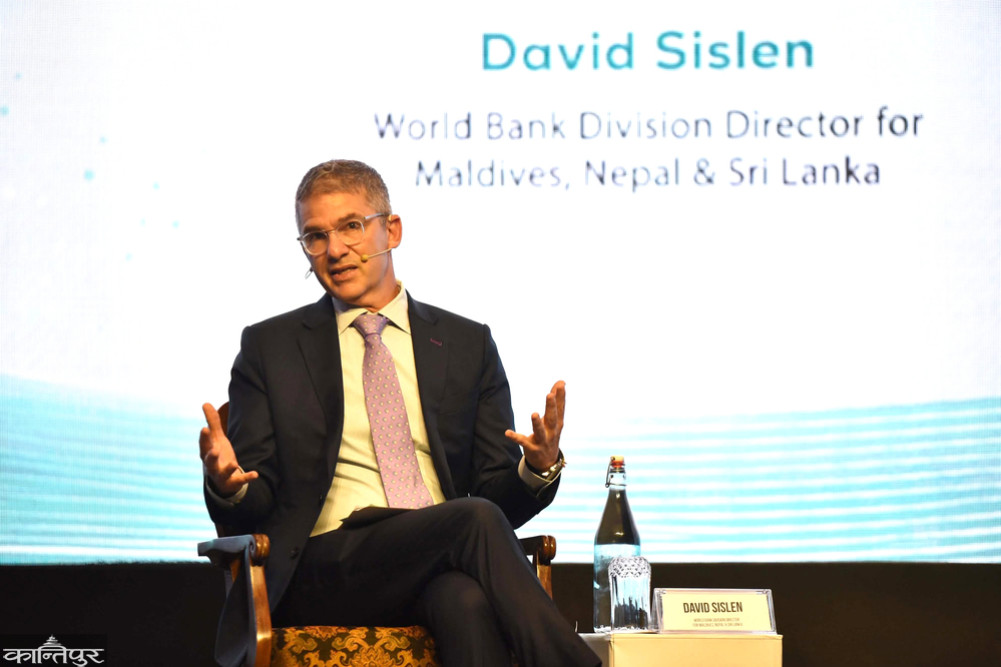
World Bank Country Director David Sislen has said that job creation remains a major challenge in Nepal, warning that if the current situation continues, large numbers of Nepalis will keep leaving the country for foreign employment. Speaking at an event, he cautioned that within the next few years, a number of people equivalent to the population of Kathmandu could migrate abroad.

He stated that employment generation is the biggest challenge for Nepal’s economic development and future. Speaking during the opening session of the Kantipur Economic Summit 2026, Sislen noted that during the 21 months he has been in Nepal, around 1.2 million Nepalis have left the country. He expressed concern that if this trend continues, within the next four years the number of people leaving Nepal could equal Kathmandu’s entire population. His remarks suggested that conditions are still not favorable enough for people to remain in the country, as the number of people going abroad continues to rise every day.
At a time when artificial intelligence is disrupting jobs in the global market, he also drew attention to the condition of foreign employment. According to Sislen, the World Bank has placed the issue of job creation as a top priority in its agenda for Nepal.
To achieve this goal, Sislen emphasized the need for reforms in three key areas: infrastructure, policy, and finance. In the infrastructure sector, he pointed out that Nepal was able to spend only 59 percent of its capital budget last year. He also described uncertainty in Nepal’s tax system as a major problem.
“Although Nepal’s banking sector accounts for 12 percent of the country’s GDP, there are problems in mobilizing capital,” he said. “Nepali banks mainly focus on collateral-based lending, while venture capital and seed funding such as angel investment have not been properly distributed in the market.”
He stressed that meaningful reforms in all three sectors are essential for private sector development and job creation in Nepal.