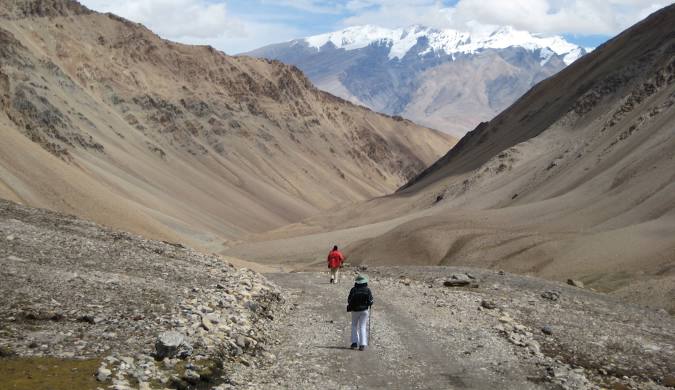
A controversy has recently emerged after India’s Ministry of External Affairs announced that 10 groups of Indian pilgrims, totaling 50 people, would travel via Lipulekh for the Kailash Mansarovar pilgrimage between June and August. The issue has sparked concern in Nepal, as the route passes through Nepali territory without prior consultation or consent.

In recent years, New Delhi has repeatedly cited the Panchsheel Agreement signed between India and China on April 29, 1954. However, the dispute has resurfaced once again amid continued concerns that India has been encroaching on Nepali territory.
Former Director General of Nepal’s Department of Survey, Punya Prasad Oli, argues that when the 1954 agreement was signed between India and China, Nepal and China had not yet even established bilateral relations, and Nepal was not consulted. Therefore, he says, it cannot be accepted as a valid basis.
He further explains that when Nepal and China demarcated their border in 1960, Lipulekh was not defined as a tri-junction point but rather as the endpoint of the surveyed area. Since the agreement was made without consulting Nepal, he questions how it can be internationally valid. According to him, the dispute should be resolved based on the Sugauli Treaty, using the Kali River as the boundary.
Oli also notes that during the time of the Sugauli Treaty, Nepal rejected claims over the Kawa Khola, after which the British recognized three other villages as part of Nepal. This is also reflected in maps produced by British India after the treaty. However, the Indian side argues that ambiguities in the Sugauli Treaty have prevented resolution, as while the treaty defines Nepal’s western boundary as the Kali River, it does not specify the river’s exact source.
What does the 1954 Panchsheel Agreement say?
Article 3 of the 1954 agreement allows pilgrims from both countries to travel to each other’s territories. It states that Indian pilgrims, including followers of Hinduism and Buddhism, can visit Mount Kailash (Kang Rinpoche) and Mansarovar in Tibet.
Similarly, Tibetan lamas and Buddhist pilgrims are allowed to visit traditional religious sites in India such as Varanasi, Sarnath, Gaya, and Sanchi. The agreement also mentions that pilgrims traveling to Lhasa can receive similar facilities.
The agreement specifies six passes and routes through which traders and pilgrims from both countries can travel: Shipki La, Mana Pass, Niti Pass, Kungri Bingri Pass, Darma Pass, and Lipulekh Pass. Pilgrims and traders are allowed to travel through these designated routes by registering at border points and obtaining permits.
Another former Director General of the Department of Survey, Buddhi Narayan Shrestha, says the 1954 agreement was supposed to be renewed every 10 years, but it was not renewed due to war between India and China. Therefore, he argues, the agreement has expired and is no longer valid, despite India continuing to reference it. He adds that while the agreement was originally intended for limited cross-border movement of local people, it is now being broadly interpreted.
In May 2015 (Jestha 2072 BS), during a meeting in Beijing between Indian Prime Minister Narendra Modi and Chinese President Xi Jinping, Lipulekh was again mentioned in a bilateral understanding. Without Nepal’s consent, both sides agreed to expand border trade through Nathu La, Qiangla-Lipulekh, and Shipki La. This has further intensified the dispute.
The Government of Nepal continues to refer to the Sugauli Treaty as the basis for resolving the issue. According to maps from 1821, 1827, 1856, and a Chinese-language map published in 1905, not only Lipulekh but also areas such as Gunji, Kuti, Nabi, Dolingtyang, and Limpiyadhura belong to Nepal, says Buddhi Narayan Shrestha.
This is because these areas lie east of the Kali River originating from Limpiyadhura. Located at an altitude of about 5,532 meters, Limpiyadhura is considered the main source of the Mahakali River and lies further northwest of Lipulekh.